NBA Finals preview: How the Knicks will win their first title in 53 years
A special NBA Finals preview edition of the NBA rundown featuring key factors and film.

The storylines are endless: a rematch of the 1999 Finals, an improbable Knicks resurgence, and an alien’s arrival. The basketball should be just as compelling. For the NBA and every person who loves the sport, this is a dream Finals.
Below is a comprehensive series preview featuring six sections and film breakdowns from the Knicks and Spurs’ regular-season meetings:
Limiting Victor Wembanyama’s defensive impact
Karl-Anthony Towns’ role
The importance of Brunson’s pull-up shooting
How New York will guard Wembanyama
Offensive rebounding
The transition game
My official prediction is at the end. Enjoy.
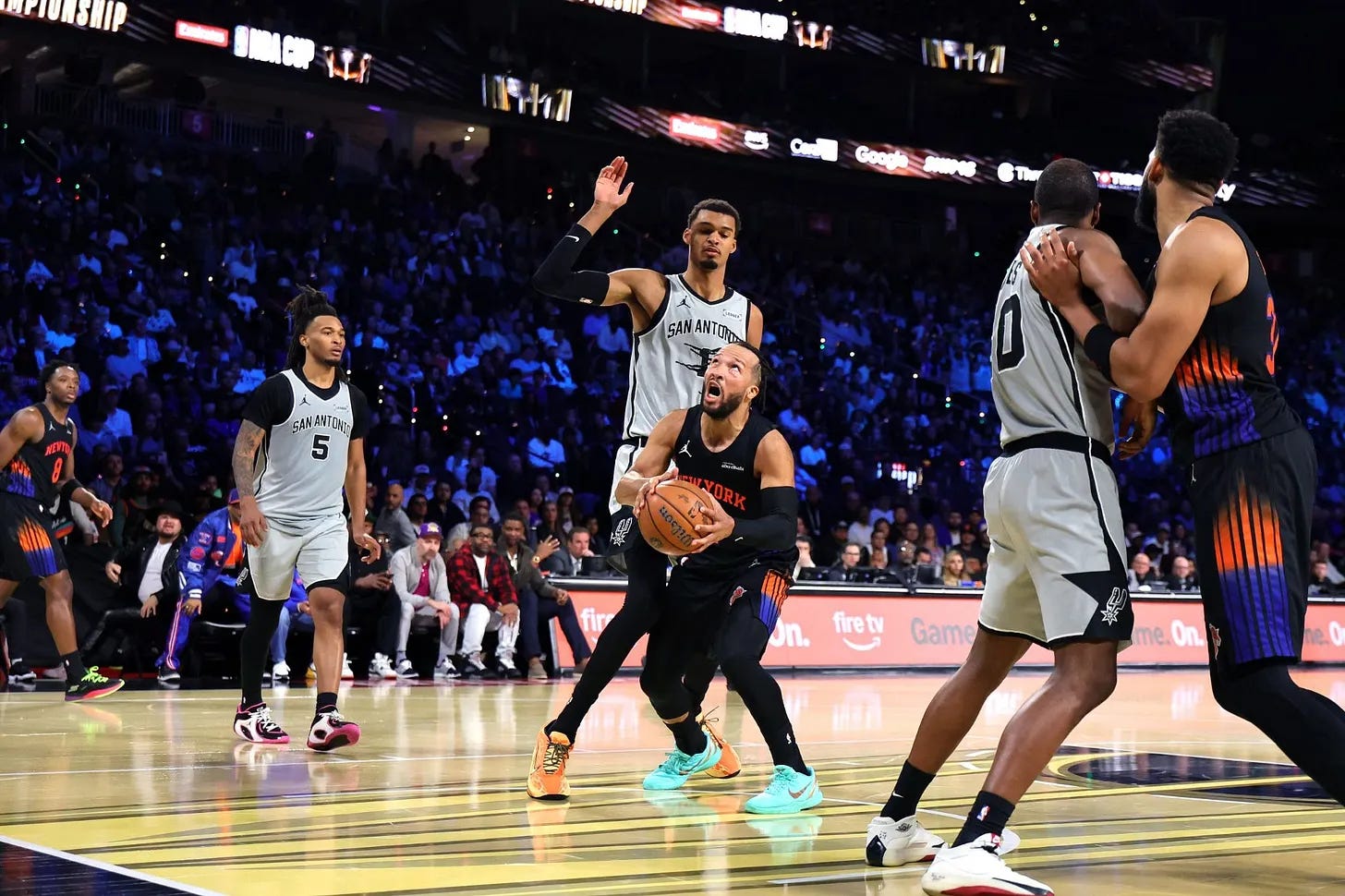
(Photo courtesy: Getty Images)
How to solve the Wemby equation
Since Josh Hart became a Knick, every coaching staff entering a playoff series against New York has debated the same question: How and who should guard him?
The Spurs will assign Victor Wembanyama to Hart, daring him to shoot while using Wembanyama as a roaming defender to shut down the paint. As simple as it sounds, Hart must make shots to stay on the floor and force San Antonio to adjust.
He struggled in Game 1 against the Cavaliers, who employed a similar strategy by putting their big man on Hart and giving him space to fire from deep. After a 1-for-5 shooting display in the series opener and a 0-for-3 start in Game 2, Hart hit five of his next eight threes.
The key to unlocking the Spurs’ defense is pulling Wembanyama — arguably the best rim protector in NBA history — away from the basket. Hart’s shooting is central to that equation. He’s connecting on just 30% of his attempts in the playoffs. Hart went 1-for-10 from three in his two regular-season meetings against San Antonio, while Wembanyama frequently guarded him.
And by guarded, I mean ignored.
This is an ideal possession for the Spurs:
When a big man defends Hart, he’ll often set ball screens to drag that defender away from the rim. New York repeatedly featured Hart as a screener against the Spurs. In the clip above, Stephon Castle chases Brunson while Wembanyama stays in drop coverage, leaving Hart open. Instead of taking the three, Hart turns it down for a contested mid-range jumper, an example of the shooting hesitation that has occasionally plagued him.
This is exactly how the Spurs will guard Hart. It’s up to him to have the confidence to take - and make - those threes.
However, negating Wembanyama’s impact isn’t all about Hart’s shooting. The Knicks have found other ways to pull the Spurs’ center away from the rim. Using Hart as a screener is one option, but involving him as a facilitator forces Wembanyama into the action.
“You just hope a guy like that, you can find ways to make him work,” Knicks coach Mike Brown said Monday of Wembanyama.
The Knicks forced Wembanyama to move in their previous meetings. Here’s a play from their last contest that shows how the Knicks’ creativity can keep him occupied when he’s guarding Hart:
The Spurs used ghost coverage against Alex Caruso, but he drilled 50% of his threes in the Western Conference, forcing the Spurs to adapt. The Cavaliers implemented a similar tactic with Jarrett Allen playing free safety off Hart. While Hart has a long leash, Brown benched him for Landry Shamet during the Knicks’ 22-point comeback in Game 1.
Both coaching staffs have the blueprint for this chess match. But if Hart is making open threes, the Knicks won’t need counters or creative wrinkles. They might already have the Spurs in checkmate.
Karl-Anthony Towns and a five-out lineup
Hart’s deployment won’t be the only tactic to pull Wembanyama away from the rim. New York is one of the few teams that start a prolific shooting center. Karl-Anthony Towns is shooting 49% from three this postseason and owns a career 40% mark from deep. When the Knicks feature lineups with five reliable shooters, Wembanyama must guard on the perimeter.
In those instances, Wembanyama could defend Towns, whose shooting will stretch the unanimous Defensive Player of the Year away from the rim. Even if Wembanyama guards someone else, it’ll create driving lanes for Towns:
Anunoby’s drive-and-kick forces the Spurs’ defense into rotation and scrambles the initial matchups. Towns rejects the inverted ball screen and blows past Harrison Barnes (Jose Alvarado’s cut clears the path). With Wembanyama reluctant to help off Anunoby — a 39% 3-point shooter — in the strong-side corner, Towns earns an easy rim attack.
Below, Towns again rejects an inverted ball screen. This time, Wembanyama rotates over from the weak side, leaving a wide-open shooter:
Oklahoma City doesn’t roster as many respectable shooters as the Knicks, and Towns is both a more willing and accurate 3-point shooter than Chet Holmgren. His offensive versatility presents a greater defensive challenge than anything the Spurs have seen this postseason.
Pull-up, splash
It’s easier to get into Carbone without a reservation than it is to reach the paint against the Spurs. One of the NBA’s most efficient scorers and elite finishers, Gilgeous-Alexander shot 55% from the field and 60% in the paint during the regular season. Against San Antonio, those numbers plummeted to 40% and 43%, respectively.
The Spurs’ interior defense places an even greater premium on outside shooting. The Thunder didn’t have enough shooting to topple the Spurs, particularly struggling on pull-up jumpers. Oklahoma City shot 34% from three and 31% on pull-up threes in the series. Gilgeous-Alexander made only 22% of his pull-up triples after shooting 38% on those attempts during the regular season.
Consistently knocking down pull-ups is critical against a defense anchored by an 8-foot wingspan lurking in the paint. Without that weapon, the Thunder failed to generate enough offense.
Brunson is a better pull-up shooter than Gilgeous-Alexander, while Mikal Bridges and OG Anunoby can also punish drop coverage. New York shot 38% on pull-up jumpers during the season.
Watch Brunson step into a three against the Spurs’ drop coverage:
And another one:
Castle hounded Gilgeous-Alexander throughout the conference championship, knowing Wembanyama was behind him as a second line of defense. Castle will likely guard Brunson initially, and the Knicks’ captain must capitalize on pull-up chances when he creates separation coming off screens.
How will the Knicks guard Wemby?
Towns and Robinson will draw most of the primary Wembanyama assignments, with Anunoby often cross-matched onto him. Anunoby and Towns each defended Wembanyama for roughly the same amount of time between the three regular-season meetings.
Wembanyama’s only efficient outing against New York came when Robinson was unavailable. He scored 31 points on 12 shots on New Year’s Eve, but shot 44% from the floor in the other two matchups.
Robinson underwent pinky surgery last week and is expected to play in Game 1 with a brace on his hand. His availability is crucial to limiting Wembanyama. Towns is addicted to committing dumb fouls. Against another dominant force in Joel Embiid, Towns committed 4.5 fouls per game in the second round. Wembanyama has drawn more than six fouls per game this postseason, making Towns' discipline especially important. The Knicks can't afford an early trip to the bench from their All-Star center.
New York could turn to Anunoby earlier than expected to protect Towns from foul trouble. The Thunder experimented with smaller, more physical defenders to push Wembanyama’s touches away from the rim. He eventually overpowered them, averaging 27.3 points and 10.9 rebounds in the series.
Anunoby presents a different challenge. His combination of strength, length, and quickness has made him one of the league’s most effective Wembanyama defenders.
Regardless of who draws the assignment, the Spurs frequently ran pindowns involving Brunson’s defender to free Wembanyama and get him charging downhill:
When Anunoby guards Wembanyama, Towns is forced onto a shooter. In the regular season, he was defending Barnes. However, Barnes has since been benched for Julian Champagnie. Towns chasing Champagnie isn’t ideal, but nothing is when mapping out a defensive strategy against Wembanyama.
Expect Towns to open the series as Wembanyama’s primary defender, with Anunoby rotating onto him just as frequently throughout the series.
A putback party
During Michigan’s run to the national championship, head coach Dusty May explained that some of point guard Elliot Cadeau’s misses in the Final Four weren’t really misses at all.
Ahead of a matchup with Arizona, Michigan practiced shooting high off the backboard and over the rim against a towering frontcourt rotating over in help, creating weak-side rebounding and putback opportunities for its big men.
I’ve thought about that often while watching the Spurs in the playoffs. Weak-side rebounds are frequently available because of Wembanyama’s aggressiveness as a shot blocker. Drivers often hesitate when they see him rotating over, but there’s value in misses that take the shot-blocking menace out of the play.
In the two games Mitchell Robinson played against San Antonio, the Knicks outrebounded the Spurs by 29 and collected 41 total offensive rebounds.
The Spurs led the league in defensive rebounding percentage during the regular season, but faltered against New York, one of the NBA’s best offensive rebounding groups. The Knicks have grabbed 34% of their misses this postseason, posting one of the three-best offensive rebounding rates in the playoffs.
How effectively New York can generate extra shots will depend on Robinson’s availability. He averaged the league’s third-most offensive rebounds per game. The Knicks rank first in second-chance points during the playoffs, while the Spurs have allowed the third-most.
New York can still punish San Antonio on the glass without Robinson. One of the many advantages of pulling Wembanyama away from the rim is the offensive rebounding chances it produces.
In the above clip, Wembanyama cuts off a Bridges drive and helps off Hart, but Wembanyama's late contest creates an opening for Towns to crash the glass. New York will prioritize the offensive boards whenever it successfully forces Wembanyama to guard on the perimeter.
Run, New York, run
Another way to counteract Wembanyama's impact? Beat him down the floor. The Knicks scored a wildly efficient 1.056, 1.962, and 1.278 points per transition possession in their three matchups against the Spurs.
This is where Hart can showcase his offensive value. He’s one of the league’s most dangerous transition players, and San Antonio has allowed the fourth-most transition points per game this postseason, largely because of its turnover issues.
The Spurs’ backcourt, led by Castle, was a turnover factory in the Western Conference finals. New York’s perimeter defenders — Anunoby, Hart, Bridges, McBride, and Shamet — should create live-ball turnovers and transition opportunities.
Against the league’s best half-court defense, generating easy offense in transition and through the offensive glass will be crucial to New York’s success.